

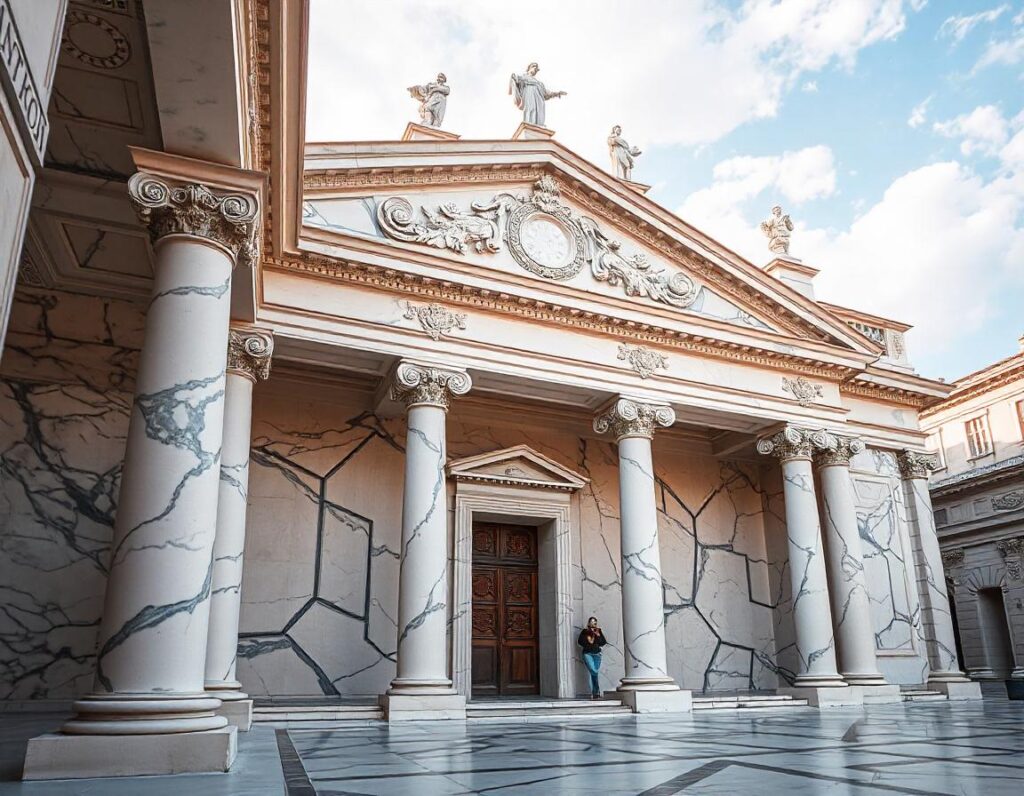
The timeless grace and majesty of classical architecture are mostly due to marble’s everlasting beauty and durability.
Since ancient Greece and Rome, marble has been a preferred material for building because it is timeless. It now stands for wealth, power, and artistic accomplishment because of its exceptional capacity to reflect veining and light. Because of its longevity, ancient civilizations were able to build enduring monuments that demonstrated their architectural and artistic prowess. Marble witnessed a comeback in prominence during the Renaissance when its elaborate carvings and imposing façade reflected humanism and the return to classical values. This material bridges the gap between the past and present by continuing to inspire modern historic buildings
The history of marble in architecture
The first historic buildings made of marble were discovered in ancient Greece, and the practice has been used in construction for thousands of years. Because of its strength and inherent beauty, marble swiftly established itself as a common material for architectural projects and was used in public buildings, theaters, and temples. Its use represented luxury and sophistication, and its resistance to weather and time made it a perfect choice for large-scale projects. Marble’s lasting use in classical and later architectural forms worldwide was made possible by the techniques that ancient architects and craftsmen learned to polish and carve the material.
In Greek architecture, marble plays an important role.
In ancient Greece, people prized marble for its beauty and used it frequently to build temples honoring the gods. The Parthenon in Athens is one example of how Greek architects used marble to construct imposing yet elegant structures. Greek marble, particularly the delicately golden Pentelic marble, came to represent artistic and architectural success. In addition to being useful, these marble constructions served as symbols of the Greek principles of harmony, balance, and order. These days, they serve as outstanding illustrations of marble’s durability and ongoing inspiration.
Magnificent Marble Structures of the Roman Empire
By using marble extensively, the Romans developed Greek methods. They brought marble from all around their empire, notably the highly valued Carrara marble, which is known for its exquisite texture and brilliant white color. Roman emperors built statues, palaces, and temples that exuded grandeur using marble as a sign of their power and authority. Roman architects’ mastery of marble is displayed in iconic buildings like the Pantheon and the Roman Forum. In addition to its beauty, this material was prized for its ability to build strong, long-lasting monuments that demonstrated the empire’s might, prosperity, and enduring influence.
Byzantine and Medieval Architecture Using Marble
Marble’s importance in Byzantine and medieval buildings persisted. It was utilized by Byzantine architects to lend luxury and spiritual symbolism to religious structures. Churches like the Hagia Sophia often used marble to symbolize the sublime splendor of heaven on their walls, floors, and elaborate mosaics. Marble in shades of green, red, and purple was also used during this period to create depth and richness. Marble uses less frequently during the Middle Ages, although it was still an important feature of European palaces and churches, signifying wealth and power.
Marble’s Renaissance Resurgence in Art and Architecture
Marble played a key role in the resurgence of Greco-Roman ideals throughout the Renaissance, which saw a resurgence of interest in classical buildings. The qualities of marble, particularly Carrara marble, served as inspiration for Michelangelo and other Italian sculptors and architects. During this time, marble’s beauty and adaptability were demonstrated by masterpieces like Michelangelo’s David and the Florence Cathedral. Renaissance architects created magnificent buildings and artwork by deftly fusing form and function with marble. Marble’s reputation as a preferred material for architects and artists looking to uphold and restore traditional values was further cemented during this time.
The Function of Marble in Neoclassical Architecture
Ancient Greek and Roman architecture had a significant effect on the 18th and early 19th century movement known as neoclassicism. During this time, marble enjoyed a resurgence in monuments, museums, and public buildings, particularly in North America and Europe. Neoclassical architecture is reflected in buildings like the British Museum and the White House, which employ marble to communicate refinement, power, and order. The endurance and beauty of marble, according to the architects of the time, symbolized an idealized return to classical principles. Marble’s uses in neoclassical architecture helped to cement its reputation as a material that radiates majesty and elegance.
In architecture, marble plays a significant symbolic role.
Marble has had symbolic meaning throughout history. Because of its inherent beauty and durability, it frequently stands for purity, perseverance, and perfection. Marble was used by ancient nations to pay tribute to their kings, gods, and cultural accomplishments. Architects expressed ideas of strength, spiritual devotion, and creative commitment by using marble in temples, statues, and palaces. Marble’s symbolic attributes are still present today. As it is frequently employed to symbolize timeless ideals and accomplishments in government buildings, museums, and memorials.
Techniques for Marble: From Quarry to Masterpiece
Over the decades, marble quarrying, cutting, and polishing techniques have changed. Marble was chiseled and shaped by artisans in the past using basic tools. New methods over time made it possible to create more precise and complex designs. Improvements in stone-cutting techniques during the Renaissance allowed the creation of intricately detailed and symmetrical sculptures and architectural elements. Modern technology speeds up and improves the efficiency of dealing with marble. Marble is a timeless material, nevertheless, ancient techniques are still prized for their artistry and capacity to highlight its inherent beauty.
Famous Marble Buildings Across the Globe
Marble has been used to construct some of the most well-known structures in the world, including the Lincoln Memorial in the United States and the Taj Mahal in India. The strength, durability, and unmatched beauty of marble are all reflected in each construction. Marble is used to enhance architectural grandeur and serve as a marker of cultural and historical value in several structures, such as the Acropolis and St. Peter’s Basilica. Because of its ageless appeal, marble continues to bridge the past and present. As evidenced by the stories each monument conveys about its era.
Interior and Architects Designers Use Marble Today
Marble is still a popular material in modern and traditional interior design and architecture today. Contemporary designers and architects use marble to add elegance and sophistication to public areas, workplaces, and residences. Marble is frequently linked to classical architecture, however, it can also be used in modern and minimalist designs. Because of its classic charm, it can be used as statement pieces, countertops, or flooring. Marble’s versatility shows its enduring appeal and ensures that it will always Be a depiction of elegance, regardless of the period.
Why Marble Was the Material of Choice for Classical Architecture
Sturdiness and lifespan
Resilience in All Elements:
Marble is perfect for buildings intended to endure for millennia because of its inherent capacity to resist weather and time.
Timeless Appeal:
Marble preserved the essence of traditional buildings by remaining intact and visually appealing throughout generations.
Visual Appeal
Marble’s smooth and glossy surface made it ideal for elaborate sculptures and carvings, enabling artists to produce realistic, detailed depictions.
Grand Structures and Temples:
Because of this characteristic, marble was a popular material for monuments, statues, and temples that displayed the civilization’s magnificence.
Adaptable Color Scheme
Range of Colors:
Architects utilized marble’s inherent differences to create depth and vitality, ranging from pure white to shades of red, green, and black.
Color Symbolism:
The range of colors allowed each item to represent several ideas, such as riches, power, or purity, which helped tell the story of the architecture.
Cultural Significance and Symbolism
A Material of Power and Respect:
Marble was more than just stone; it represented wealth, cultural identity, and respect and was frequently utilized in public and religious settings.
Statement of Artistry and Identity:
Marble was an emblem of ancient civilizations’ architectural legacy, symbolizing their cultural values, artistic accomplishments, and aesthetic vision.
Conclusion
Marble has played a continual role in classical architecture throughout history, reflecting shifting cultural aesthetics and values. Marble has continuously stood for beauty, toughness, and cultural accomplishment in everything from Greek temples to Renaissance sculptures. Marble’s special properties were employed by every civilization to express its goals and values. Its ageless charm continues to impact and reminds us of earlier beauty and skill. The enduring influence of ancient methods is seen in the ways that the forms and techniques created in classical marble architectural design are still relevant in modern formatting. Marble exhibits human ingenuity and beauty while acting as a link between the past and present.
